
ACADEMY OF DEVELOPMENT MANAGEMENT – INSTITUTE OF SKY POLITICS
What underlies the demand of the Russian MFA for peace in Ukraine
The diplomacy of the Russian MFA set out the root cause of the armed conflict in the Ukrainian theater of operations in the "Ryabkov Ultimatum" of 15.12.21 addressed to the USA and NATO.
On 02.12.21 in Stockholm, Minister S. Lavrov threateningly stated: "Ignoring Russia's legitimate concerns, drawing Ukraine into the geopolitical games of the USA against the backdrop of the deployment of NATO forces in the immediate vicinity of our borders will have the most serious consequences and will force us to take retaliatory measures to correct the military-strategic balance." Long-term security guarantees could be an alternative to this.
On 15.12.21 in Moscow, drafts of the Treaty between the Russian Federation and the United States on security guarantees and the Agreement on measures to ensure the security of the Russian Federation and the member states of NATO, setting out concrete legal demands, were handed over to the US Assistant Secretary of State.
The essence of the demands is no NATO bases anywhere in the entire post-Soviet space and in the West up to the 1997 line! Otherwise Russia will respond with military and military-technical means.
The main demands were rejected by NATO and the United States on January 26, 2022; a month later, on February 24, Russia launched a Special Military Operation to denazify and demilitarize Ukraine.
But then the question arises: Why is the Kremlin not afraid of NATO threats on Russia's border in the Baltic countries and in Finland, while in Ukraine the world has come to an end?
Sky Politics found the answer to this question in four things:
• In the foundations of the titles of the first king of Rus’ from the line of the Kievan branch of the Rurikids, Daniel of Galicia (from 1253 crowned by Pope Innocent IV) and of the first tsar of all Rus’ from the line of the Moscow branch of the Rurikids, Ivan IV the Terrible (from 1547 crowned to the throne according to the Orthodox rite).
• In the history of the reunification of Ukraine with Russia in 1654. The Hetman of the Zaporozhian
Cossacks, Bohdan Khmelnytsky, appealed with a petition to enter the service of the Russian tsar Alexei Mikhailovich. The request was granted and approved by the Zemsky Sobor in Moscow.
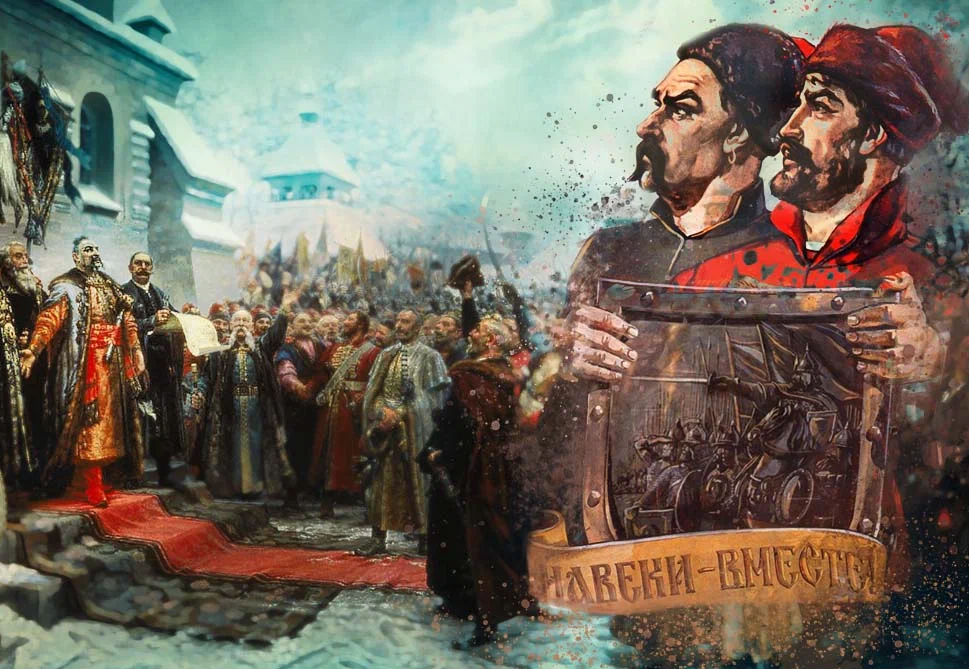
The motivating cause of the transition was the deliverance of the population of Orthodox Little Rus’ from religious and social oppression on the part of the szlachta and the Catholic clergy of the Polish-Lithuanian Commonwealth. In the summer of 1654, a long, bloody and large-scale war between Russia and the Polish-Lithuanian Commonwealth began, lasting for 13 years.
• In the establishment by the German Catherine II the Great in 1791 of the Pale of Permanent Settlement for the residence of Jews on the territory of the Russian Empire, which made Belarus and Novorossiya (the northern Black Sea region) a zone of exclusion for the Jews, who became unreliable "stepchildren of Russia."
• In M. Bulgakov's novel "The White Guard," which describes the events of the Civil War in Ukraine at the end of 1918. Where the collapse occurs of the world of the Russian intelligentsia and the sovereign will of the army officers who defended Kyiv from Ukrainian nationalists led by Petliura. Petliura occupies the city, but after 47 days surrenders it to the Bolsheviks.
In 1926, M. Bulgakov, based on the novel, wrote for the Moscow Art Theater the play "The Days of the Turbins." Memoirists assert that this was Stalin's favorite play, which he watched 17 times.
The leader's reaction to the production is curious. In February 1929 he wrote: "If even people like the Turbins are forced to lay down their arms and submit to the will of the people, recognizing their cause as finally lost — then the Bolsheviks are invincible... For Stalin — a man who never believed anyone — "The Days of the Turbins" was a tragedy of the betrayal of the old elite by both their own and their allies.

The above retrospective of the origins and causes of the armed conflict around Ukraine in our time allows us to rise above the vanity of the current moment to the level of historical generalizations.
So then, the root cause of the danger For the Kremlin, the root cause of the events surrounding Ukraine lies in the specific culture of the population—by everyday, linguistic, and religious factors, by archetype and genotype (the call of the heart and the voice of the blood)—divided between those drawn to the West and those drawn to the East, yet equally rejecting the Asian type of power of "Eastern despotism," inherited by Moscow from the Horde.
The experience of resolving the contradictions of heterogeneous internal and external forces in 1918 shows that even now the "ruin" of the hybrid war in Ukraine can be overcome by a maneuver upward—into the supersystem of a new Union of Free Sovereign Republics (USSR-2) led by the Bolshevik-Leninists of our day.
Executed by Andrey Devyatov No1005 dated 27.02.25

Comments 1
Анонимный участник devyatov.su
Первое, что ожидается от Девятова, так это чтобы он престал ВРАТЬ... беззастенчиво врать "правдой". Перестал выпячивать "почтальона Печкина" (МИД, Рябкова), уводя в тень МИДа кремлёвского упыря... Так пресловутый ультиматум (требования), во-первых был не от МИДа, а от Путина (МИД к БЕЗОПАСНОСТИ государства и её ГАРАНТИЯМ никакого отношения не имеет), а во-вторых, требования (кремлёвской Zалупы) были ЗАВЕДОМО НЕВЫПОЛНИМЫ, а потому явились лишь ПРЕДЛОГОМ (поводом), а не причиной вероломного (без объявления войны, как истинные нацисты) нападения на Украину: "15 декабря 2021 года российский президент Владимир Путин передал помощнице госсекретаря США Карен Донфрид «конкретные предложения» о «гарантиях безопасности», которые Россия желала от Запада. Спустя два дня, 17 декабря МИД РФ на своем сайте опубликовал эти документы. Проекты договоренностей назывались «Договор между Российской Федерацией и Соединенными Штатами Америки о гарантиях безопасности» и «Соглашение о мерах обеспечения безопасности Российской Федерации и государств-членов Организации Североатлантического Договора». Российский проект договора с США в частности предусматривал: 1. Отказ США от создания военных баз в государствах бывшего СССР и прекращение любого военное сотрудничества с ними; 2. Обязательство США исключить дальнейшее расширение НАТО на восток и отказ от приема в Альянс государств бывшего СССР; 3. Отказ России и США от развертывания ракет средней и меньшей дальности в местах, из которых они могут поражать цели на территории другой стороны; 3. Обязательство сторон не развертывать ядерное оружие за пределами своих границ; вернуть оружие, развернутое ранее вне национальных территорий; ликвидировать зарубежную инфраструктуру для размещения ядерного оружия; не проводить учений с отработкой применения ядерного оружия; не обучать военных неядерных государств применять ядерное оружие; 4. Обязательство сторон воздержаться от полетов тяжелых бомбардировщиков вне своего неба и от присутствия боевых кораблей в районах вне национальных вод, откуда могут быть поражены цели на территории другой стороны; 5. Невмешательство во внутренние дела, включая отказ от поддержки организаций, групп и отдельных лиц, выступающих за „неконституционную смену власти“, а также любых действий, имеющих целью изменение политического или социального строя одной из сторон. Проект России договора с НАТО предусматривал: 1. Вывод с территории стран, ставших членами НАТО после 1997 года, всех вооружённых сил и военной инфраструктуры иностранных государств, появившихся там за последующие годы; 2. Исключение дальнейшего расширения НАТО, в том числе присоединения Украины, а также других государств; 3. Отказ НАТО от любой военной деятельности на Украине, в Восточной Европе, Закавказье и Центральной Азии; 4. Подтверждение того, что стороны «не рассматривают друг друга в качестве противников» и готовы «мирно решать все международные споры, а также воздерживаться от любого применения силы»; 5. В целях «исключения возникновения инцидентов» стороны обязываются отказаться проводить военные учения и другие действия «свыше бригадного уровня» в согласованной приграничной полосе; 6. Создание горячих линий для экстренных контактов между Россией и НАТО." p.s. Хотя ожидание от всякого московита, у которых основные "добродетели" - это два "В": ВРАНЬЁ и ВОРОВСТВО, ожидание искренности, честности и правды - пустое...
Original · translation not yet available